Executive Summary: What We Hunted For and Why
Hunt Objective: determine whether the suspicious Shift.exe activity identified during an internal investigation was also present in managed customer environments, whether it showed the same risky behavior, and whether any action was required to reduce customer risk.
A note on hunt types
ISI conducts three types of threat hunts: indicator-based (triggered by an artifact or behavior already observed), threat intelligence-based (triggered by an external report or feed), and hypothesis-based (testing a plausible attack scenario before anything has been observed). This hunt was indicator-based: activity seen in one environment led ISI to search for the same indicators across applicable managed environments.
What we did
The ISI Cyber team searched applicable managed environments with available endpoint and SIEM telemetry for this application, evidence it had run, persistence mechanisms that could survive a restart, and suspicious outbound internet activity tied to it.
What we found
Shift.exe was identified on a limited number of isolated endpoints within the environments reviewed. We did not observe the more serious behavior that triggered the hunt, including active scareware delivery, suspicious outbound network communication, or lateral movement in customer environments.
Action items and results
Every affected endpoint was remediated remotely. ISI stopped the application where it was running, removed the associated files and persistence mechanism, and then revalidated the endpoints to confirm the identified artifacts were no longer present.
Why this matters
This hunt reduced uncertainty before it could become a customer-impacting issue. ISI did not wait for a customer to report a problem. We expanded the investigation, remediated affected systems, validated the result, and converted what we learned into stronger standing detection coverage. No customer action is required at this time.
Security Outcome
The hunt produced a measurable security outcome, summarized below.
|
Outcome Area |
What This Hunt Demonstrated |
|
Risk identified |
PUA activity with auto-start persistence and scareware-associated behavior warranted broader validation. |
|
ISI action |
Hunted applicable telemetry, validated findings, remediated affected endpoints, and rechecked the environment. |
|
Result |
No active scareware delivery, suspicious outbound communication, or lateral movement was observed in customer environments reviewed. |
The sections below cover full technical detail: methodology, indicators of compromise, MITRE ATT&CK mapping, and supporting evidence. Skip ahead if the summary above is all you need.
Technical Detail
Triggering Event and Background
The hunt began after ISI detected scareware-related activity on an internal endpoint tied to a third-party browser application, Shift.exe. Shift.exe is categorized as a Potentially Unwanted Application (PUA): not necessarily malware, but software that can introduce risk through deceptive behavior. In this case, it auto-started at logon, used a registry Run key to persist across reboots, and reached out to an external domain that served scareware pop-ups designed to pressure users into taking action. Those observed behaviors, not the PUA classification alone, justified a broader hunt across applicable managed environments.
Hunting Scope and Methodology
ISI searched Microsoft Sentinel and Defender telemetry, supplemented by N-able endpoint data, across environments with the applicable SIEM/EDR coverage. The hunt focused on four areas: the presence of Shift.exe, evidence of execution or auto-start behavior, persistence through scheduled tasks or registry Run keys, and suspicious outbound network activity associated with the application. Findings were corroborated against available telemetry before remediation to reduce false positives.
Findings and Actions Taken
Shift.exe was confirmed on the original internal endpoint and on a limited number of isolated customer endpoints. In the customer environments reviewed, we did not observe the scareware delivery, malicious network communication, or lateral movement seen in the original incident. Persistence was observed through registry Run keys; no widespread scheduled-task persistence was identified.
For every affected system, ISI terminated the running process where present, removed the file from disk, removed the identified registry persistence, and revalidated the endpoint. Remediation was performed remotely and the identified indicators were no longer observed after validation.
Indicators of Compromise, Persistence, and Attack
IOCs (Indicators of Compromise)
- File: Shift.exe
- Malicious domain (defanged): https[:]//message2026108a9vrvs510.z13.web.core.windows[.]net/
IOPs (Indicators of Persistence)
- Registry Run key: ShiftAutoLaunch_5386AE79CA77A9A2236AE166213BA490
IOAs (Indicators of Attack)
- Unsolicited execution of Shift.exe without user interaction
- Outbound communication to the malicious domain
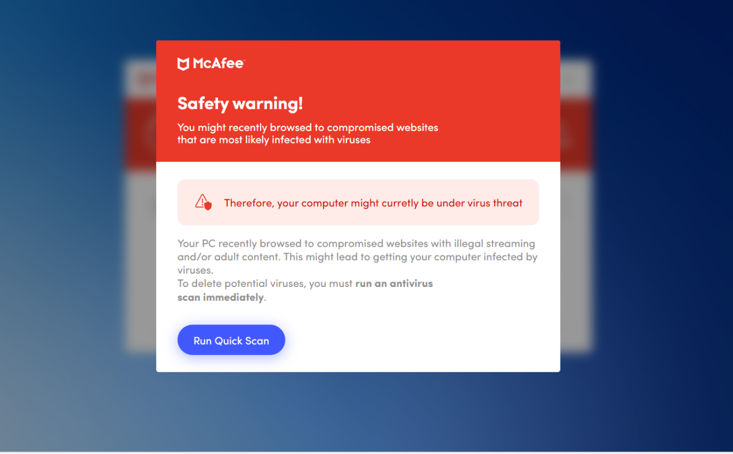
- Delivery of scareware pop-ups (see supporting evidence below)
- Execution immediately following system reboot
MITRE ATT&CK Mapping
|
Observed Behavior |
MITRE Technique |
ID |
|
Persistence through registry-based Run keys executed at logon. |
Boot or Logon AutoStart Execution: Registry Run Keys / Startup Folder |
T1547.001 |
|
Outbound HTTPS communication to known malicious infrastructure. |
Application Layer Protocol: Web Protocols |
T1071.001 |
|
Mitigation |
MITRE Category |
ID |
|
Shift.exe added to PUA block and watch list. |
Execution Prevention |
M1038 |
|
Strengthened endpoint controls to block PUAs. |
Application Control |
M1038 |
|
Increased monitoring for registry-based persistence. |
Audit and Monitoring |
M1047 |
|
User awareness on scareware and deceptive pop-ups. |
User Training |
M1017 |
Detection Improvement
This hunt also produced a new standing ABA (Attacker Behavior Analytics) detection: “Abnormal Boot or Logon AutoStart Execution via Registry Run Keys.” Registry Run keys and startup folders are common persistence mechanisms because they can automatically execute a program when a user logs on. The new detection improves ISI's ability to identify similar persistence behavior earlier and reduces reliance on a future manual hunt for the same pattern.
Threat Matrix
|
Category |
Details |
|
Threat Type |
PUA-based scareware delivery |
|
Initial Vector |
User-level execution followed by registry-based auto-start persistence |
|
Execution |
Shift.exe auto-launching post reboot |
|
Persistence |
Registry Run key auto-start execution |
|
Network Communication |
Outbound HTTPS communication to an external domain serving scareware content |
|
Impact |
Scareware delivery; user manipulation |
|
Detection |
Sentinel and Defender telemetry |
|
Remediation |
Process termination, file deletion, persistence removal |
|
Residual Risk |
Low after remediation; no residual indicators associated with this activity were observed. |
Threat Criticality
ISI rates incidents using a standard Intent x Capability framework. This activity rated Low: PUA-based scareware rather than targeted exploitation or CUI compromise, combined with limited capability at the user level. We did not observe privilege escalation, lateral movement, or credential harvesting in the customer environments reviewed. After remediation, no residual indicators associated with this activity were observed, and residual risk was assessed as Low.
Consequences of Inaction
Left unaddressed, this type of application could increase risk over time. Continued execution could expose users to deceptive content, create an opportunity for credential harvesting, allow additional payloads to be delivered, or leave persistence in place for later abuse. The value of the hunt was identifying and removing that exposure before it developed into a more serious event.
Enhancements to Security Posture
- Expanded PUA detection criteria to include Shift.exe and similar third-party browsers.
- Strengthened monitoring of registry Run key persistence and scheduled task creation.
- Enhanced cross-tenant hunting playbooks for faster validation across GCC and GCC High environments.
Supporting Evidence: Scareware Pop-up
The pop-up below impersonates a legitimate McAfee security warning, a common technique used to create urgency and pressure a user into action.
Conclusion
This hunt confirmed that the observed activity remained isolated and that the more serious malicious behavior that triggered the hunt was not observed in customer environments. Affected systems were remediated and revalidated. More importantly, the hunt produced a lasting control improvement: stronger detection for registry-based persistence and a faster cross-environment hunting process for similar activity in the future. Customer action is not required at this time.