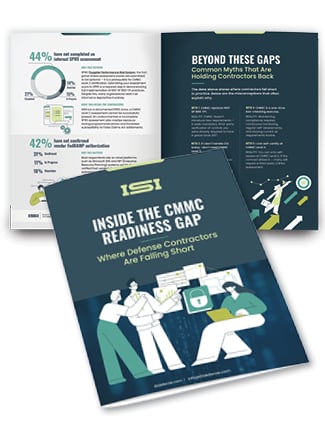
INSIDE THE CMMC READINESS GAP
Want to know where defense contractors are falling short? We surveyed 100+ contractors and the findings are striking.

Executive Brief
Hiring a Cybersecurity Maturity Model Certification (CMMC) consultant sounds like the smart move. Bring in an expert, get compliant, win contracts.
But for many defense contractors, it has become one of the most expensive mistakes they make.
Here is what we are seeing in the field:
- Consultants who claim credentials they do not have
- Generic documentation that fails under third-party scrutiny
- Scoping work that misses Controlled Unclassified Information (CUI) entirely
- Contractors left with incomplete solutions requiring a full restart
The problem is not that consultants are inherently bad. The problem is that the CMMC market in 2026 is still largely unregulated at the consultant level, and contractors are paying the price.
Dig deeper below to learn more.
Why This Is Happening Now
CMMC enforcement is accelerating. Requirements are appearing in contracts. Primes are flowing requirements down to subcontractors. And a growing cottage industry of consultants has rushed in to capitalize on contractor urgency.
The result: a marketplace full of vendors ranging from genuinely expert to dangerously unqualified, and contractors who often cannot tell the difference until the damage is done.
What makes this especially costly:
- CMMC Level 2 is effectively a 320-question exam — one wrong answer can mean a full fail at the certification level
- Inaccurate Supplier Performance Risk System (SPRS) scores can disqualify you before you bid
- False compliance claims carry False Claims Act exposure, regardless of intent
- Restarting from bad work costs far more than starting right
For more on why this is a business risk, not just a technical one, see our blog CMMC Is Not a Cyber Problem. It's a Business Risk Issue.
When Hiring a CMMC Consultant Actually Makes Sense
A consultant is not the wrong answer. It is the wrong answer without the right vetting.
There are real scenarios where outside expertise accelerates readiness and reduces risk:
- You have no internal compliance function with CMMC-specific expertise and need structured guidance from the ground up
- You are approaching a recompete or new contract award and have a compressed timeline
- Your internal team can implement controls but lacks the expertise to interpret CMMC assessment objectives correctly
- You need an objective gap assessment against NIST Special Publication (SP) 800-171 Rev. 2 that your own team cannot conduct without bias
- You are a subcontractor with prime-driven deadlines and no compliance infrastructure
The issue is not whether to hire help. It is whether you hire the right kind of help, with the right credentials, and with a clear shared understanding of scope from day one.
Red Flags When Evaluating a CMMC Consultant
Not every consultant who claims CMMC expertise has it. Here are the warning signs to watch for before signing anything.
They claim to be Certified Third-Party Assessment Organization (C3PAO) qualified without proof.
This is one of the most common misrepresentations in the market. A C3PAO is a formally authorized organization that can conduct official CMMC Level 2 assessments. Claiming that status without authorization is not just misleading, it undermines your entire compliance posture if you rely on it.
Verify C3PAO status directly through the Cyber Accreditation Body (Cyber AB) marketplace before moving forward or request their official CMMC certificate of status, which should come directly from the C3PAO that certified them.
They skip scoping.
Scoping is foundational. It defines where CUI lives, flows, and must be protected. Without proper scoping, every control you implement may be aimed at the wrong environment.
Contractors have reported being well into compliance work before discovering that their CUI environment was never properly defined. The result is unexpected work and cost that was not in the original engagement.
Use our CUI Scope Indicator tool to get a preliminary read on your scope before engaging any vendor.
They promise unrealistic timeframes.
CMMC Level 2 readiness takes most organizations several months to over a year. Scoping, gap assessment, remediation, documentation, and assessment scheduling all take time. Any consultant promising certification-ready status in days or weeks — think "CMMC ready in 7 days!" — is not describing CMMC Level 2. They are describing a shortcut that does not exist.
Their System Security Plan (SSP) is a boilerplate template.
A copy-and-paste SSP is one of the most common reasons organizations fail CMMC assessments. Assessors validate against live systems, configurations, and evidence. Generic language does not hold up.
If a consultant delivers an SSP that reads like a template and does not reflect how your organization actually operates, you are not ready for assessment. See What Should Be in Your System Security Plan for CMMC Level 2? for what good looks like.
They do not understand your business.
CMMC compliance is not a one-size-fits-all exercise. A construction company, a technical metals firm, and a software developer all have different CUI environments, different operational rhythms, and different risk profiles.
Contractors have described consultants who clearly had no understanding of day-to-day operations and were still figuring out the standard themselves. If your consultant cannot speak to how your business actually runs, they cannot build compliance around it.
They claim they can cover ALL objectives/controls for you.
No consultant or managed service provider can own your entire compliance posture. CMMC requires your organization to implement, operate, and document controls within your own environment. A partner can guide, advise, and support, but the responsibility for implementation cannot be fully outsourced. Anyone claiming otherwise does not understand how the standard works or is hoping you do not.
They rely on scare tactics.
Some vendors lead with urgency and fear rather than expertise and honesty. Contractors have ended meetings mid-pitch because of aggressive tactics designed to pressure a decision, not inform one.
A qualified partner will help you understand your real risk and your real timeline. They will not manufacture urgency to close a deal.
For a grounded view of your actual timeline, see The Three-Year Myth: The Real CMMC Timeline for Defense Contractors.
What a Qualified CMMC Partner Actually Does
The right partner does not just hand you documentation. They help you build a program that reflects how your business actually operates and can withstand third-party scrutiny.
Here is what to look for:
- Starts with scoping, not selling
- Conducts a genuine gap assessment against National Institute of Standards and Technology (NIST) Special Publication (SP) 800-171 Rev. 2, the standard that governs your Department of Defense (DoD) (also known as the Department of War) contract eligibility
- Builds an SSP that reflects your real environment, not a template
- Aligns documentation to the 320 assessment objectives that Certified Third-Party Assessment Organization (C3PAO) assessors actually evaluate
- Speaks plainly about Plans of Action and Milestones (POA&Ms), what can be deferred and what cannot
- Coordinates across IT, compliance, legal, and leadership, not just the IT team
- Holds verifiable credentials from the Cyber Accreditation Body (Cyber AB), not just a website
The Credentials That Actually Matter
The CMMC ecosystem has a formal credentialing structure. Any consultant or partner worth hiring should be able to point you to their standing in it.
Here are the credentials to ask about:
- Certified CMMC Professional (CCP): An entry-level Cyber AB credential for individuals who support CMMC readiness work. CCPs are trained on the standard but are not authorized to conduct assessments.
- Certified CMMC Assessor (CCA): A higher-level individual credential for assessors who conduct official CMMC evaluations. CCAs must be affiliated with an authorized C3PAO to perform certification assessments.
- Registered Practitioner (RP): An individual recognized by the Cyber AB who can provide CMMC consulting and advisory services. RPs are not assessors, but they are part of the formal ecosystem and are held to a code of professional conduct.
- Registered Practitioner Organization (RPO): A company-level Cyber AB designation for organizations that provide CMMC consulting services. Hiring an RPO means the firm has made a formal commitment to the Cyber AB ecosystem and its standards.
- C3PAO: The only entity authorized to conduct official CMMC Level 2 certification assessments. C3PAOs can also provide consulting and readiness services, but not to the same organization they are assessing. If a vendor is both preparing you for assessment and conducting it, ask directly how they are managing that separation. Conflicts of interest in this area are governed by 32 CFR Part 170.
- Level 2 (C3PAO) Certificate of Status: As of July 13, 2026, the Department of War (DoW) has suspended all pending and future implementation milestones in the CMMC 2.0 phased implementation plan. In short, CMMC Level 1 (Self) and Level 2 (Self) certifications are the only maturity levels contracting officers can use during this interim period. Additionally, the DoW is conducting a review of the program and will be gathering feedback on how to improve CMMC for small- and mid-sized businesses going forward. Little is known today on the future state of third-party assessments, but your current DFARS 7012 and NIST 800-171 Rev 2 obligations remain in effect.
Outside of the certificate of status, you can verify all credentials directly at the Cyber AB marketplace before signing anything. Claimed credentials are common. Actual credentials are what count.
For more on what the documentation should look like, see CMMC POA&Ms Explained: What You Can and Cannot Defer.
Start with Scoping, Not a Consultant
Before you hire anyone, you need to understand your own CUI environment. Many costly engagements start wrong because the contractor did not know what they were scoping, and neither did the consultant.
Our new CUI Scope Indicator is a free interactive tool that helps you quickly assess where CUI may live in your environment. It takes minutes and gives you a meaningful starting point for any compliance conversation.
Going into a vendor conversation with a clear picture of your scope:
- Reduces the risk of being oversold work you do not need
- Surfaces real gaps before a consultant does, on your terms
- Creates a baseline you can hold a partner accountable to
The Real Risk of Choosing the Wrong Partner
A bad consultant engagement is not just a sunk cost. The downstream consequences can be significantly worse than the original invoice.
Here is what happens when contractors choose the wrong partner:
- You restart from zero. Documentation built on boilerplate templates or mis-scoped environments cannot be salvaged for a C3PAO assessment. The work must be redone correctly, often under time pressure.
- Your SPRS score becomes a liability. An inaccurate SPRS score, whether inflated by a consultant or based on work that was never properly validated, signals elevated risk to primes and the Department of Defense (DoD). That can cost you opportunities before you ever submit a bid.
- You face False Claims Act exposure. If your organization attests to a compliance posture that does not reflect reality, that is not just a compliance gap. It is potential legal exposure. Consultants who push you to claim readiness you have not achieved put your organization at risk, not theirs.
- You miss the contract window. Recompetes and new awards do not wait for remediation cycles. If you discover the work was done wrong after a requirement appears in a solicitation, you may simply be ineligible.
- Primes deprioritize you within their supply chain. Prime contractors managing their own CMMC obligations are increasingly scrutinizing subcontractor posture. A weak or unverifiable compliance program can result in being removed from the supply chain entirely, regardless of past performance.
The common thread: the risk lands on the contractor, not the consultant.

What Contractors Should Do Before Hiring Anyone
Take these steps before committing to a consultant or compliance partner:
- Use the CUI Scope Indicator to identify where CUI lives in your environment
- Understand which contracts and programs require CMMC Level 2 certification
- Confirm any prospective partner's credentials through the Cyber AB marketplace, looking specifically for CCP, CCA, RP, or RPO status
- Ask specifically how they handle scoping, SSP development, and the 320 assessment objectives
- Get clarity on what is and is not included in any engagement before signing
- Involve leadership, legal, and compliance, not just IT, in the evaluation process
If none of these scenarios describe your situation, a consultant may not be the right investment. Organizations with a strong internal compliance function, clearly scoped CUI environments, and dedicated CMMC expertise may be better served by focused advisory support rather than a full consulting engagement.
FAQs
How do I verify a CMMC consultant's credentials?
Check the Cyber AB marketplace at cyberab.org for authorized C3PAOs, Certified CMMC Assessors (CCAs), Certified CMMC Professionals (CCPs), Registered Practitioners (RPs), and Registered Practitioner Organizations (RPOs). Each credential type has a different scope of authorized activity. Anyone claiming formal assessment authority must be listed as a CCA affiliated with an authorized C3PAO. Consulting and readiness support should come from credentialed RPs or RPOs at minimum. You can also request a Certificate of Status directly from the Cyber AB, which provides official confirmation of an organization's or individual's current standing in the ecosystem.
What is the biggest mistake contractors make when hiring a CMMC consultant?
Skipping scoping. Many contractors have invested significantly in compliance work only to discover their CUI environment was never properly defined. Without accurate scoping, controls may be applied to the wrong systems, and the entire effort may need to be restarted.
Does a CMMC consultant replace a C3PAO?
A C3PAO can provide advisory and readiness support, but not to the same organization it is assessing. The concern is not the overlap between consulting and assessment roles in general — it is whether a vendor is packaging services in ways that may conflict with 32 CFR Part 170. Be cautious of any arrangement where the same organization is both preparing you for assessment and conducting it, and ask directly how they manage that separation of duties.
Can a good SSP be built from a template?
Templates can serve as a starting point, but they must be fully customized to reflect your actual systems, tools, and processes. An SSP that reads like a template will not hold up under assessment. Assessors validate against real configurations and evidence, not intentions.
How long does CMMC Level 2 readiness take?
Most organizations need several months to over a year depending on their current posture. The process includes scoping, gap assessment, remediation, documentation, and assessment scheduling, all of which take time. See The Three-Year Myth: The Real CMMC Timeline for Defense Contractors for a realistic breakdown.
Helpful ISI Links
- CUI Scope Indicator Tool
- What Should Be in Your System Security Plan for CMMC Level 2?
- CMMC Is Not a Cyber Problem. It's a Business Risk Issue
- CMMC POA&Ms Explained: What You Can and Cannot Defer
- The Three-Year Myth: The Real CMMC Timeline for Defense Contractors
- Do You Really Need a GRC Platform for CMMC?