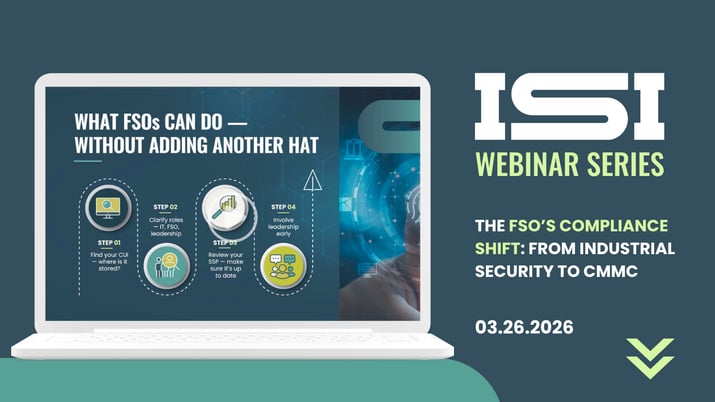
CMMC CHANGED THE FSO ROLE.
Understand where industrial security ends, cybersecurity begins, and how FSOs fit into CMMC readiness.

Executive Brief
Artificial intelligence (AI) promises efficiency, automation, and competitive advantage, but without structured Organizational Change Management (OCM), it often amplifies broken processes instead of fixing them.
- Many AI initiatives fail because they attempt to automate informal, undocumented, or inconsistent workflows.
- OCM creates repeatable, measurable processes that AI can successfully scale.
- Structured change management can drive measurable productivity gains and stronger business decisions.
Dig deeper below to learn why process maturity must come before AI adoption, especially for defense contractors navigating Cybersecurity Maturity Model Certification (CMMC) and increasing operational pressure.
AI Cannot Automate What Does Not Exist
“AI is great for the automation of process,” Bryan Champagne, President, IT and MSP Services at ISI, explains. “The problem that most people have with their AI is they're going out and they're trying to do a lot of processes that are not based on anything factual and things that people keep in their heads. So, it's a people process, not an actual established process.”
Many organizations attempt to deploy AI into environments where workflows are informal or dependent on institutional knowledge. AI may work for isolated tasks, but it struggles when asked to support cross functional business operations.
As Champagne notes, “This is the reason that a lot of companies are having AIs that work great for singular processes. But when you look at something like organizational change management, they're failing. Because they're not looking at the overall process of how everything has to come together.”
Bottom line: AI scales structure. It also scales dysfunction.
OCM introduces checkpoints, accountability, and repeatability. Those elements make automation viable.
Organizational Change Management (OCM) Is a Business Function
In the defense industrial base, OCM is often tied to compliance efforts like CMMC. Champagne challenges that narrow view.
“CMMC is really sometimes being regarded just as an IT function,” he says. “But maybe one of the things that's worthwhile for more businesses to do is to kind of sit back and ask themselves, am I better as a business if I adopt this process? Am I going to make better technology decisions? Am I going to make better business decisions for my infrastructure by adopting these type of processes?”
That reframing matters because investment decisions are not made by compliance teams alone.
“The reality is, the person purchasing it is not a compliance person. It's a business leader.”
When the conversation shifts from regulatory burden to operational improvement, leaders begin to see OCM as a driver of business performance.
Structure Drives Productivity
When implemented correctly, OCM produces measurable impact.
“By doing good organizational change management, they've seen as much as a 45% increase in productivity,” Champagne shares.
Why? Because OCM reflects what strong businesses already prioritize:
- Clear planning
- Documented processes
- Training and awareness
- Defined backup strategies
- The ability to pivot when necessary
As Champagne explains, “Everything you do in business is really about going through and having your business where you have solid plans, you have solid backups… That's really what organizational change management is.”
AI layered onto that structure accelerates outcomes. AI layered onto chaos accelerates failure.

The Strategic Imperative
For defense contractors facing CMMC requirements and competitive pressure, AI adoption is not optional. But neither is disciplined change management.
The shift must be intentional:
- From compliance burden to business enablement
- From isolated IT initiatives to enterprise-wide process maturity
- From experimentation to measurable operational impact
OCM creates the reliability and repeatability that AI depends on. It also positions security and compliance as contributors to stronger business outcomes.
For defense leaders, the question is not whether to pursue AI. It is whether the organization is structured to support it.

FAQs
How does Organizational Change Management (OCM) support AI initiatives?
OCM establishes documented, repeatable processes with checkpoints and accountability. AI can then automate and enhance those defined workflows, enabling scalability beyond isolated tasks.
Is OCM only relevant for CMMC compliance?
No. While often associated with CMMC, OCM applies across the entire business. It strengthens planning, execution, and decision making across departments.
Why should executives care about OCM and AI alignment?
Executives approve investments and are accountable for performance outcomes. Aligning AI initiatives with structured change management ensures spending translates into measurable productivity gains rather than fragmented deployments.
Helpful ISI Links
- Steal our CMMC Level 2 Readiness Strategy
- Compliance Without Compromise: CMMC Budget Guide
- An FSO’s Guide to CMMC