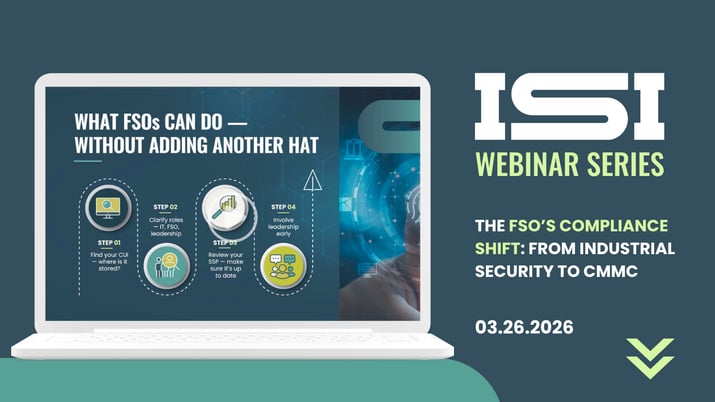
CMMC CHANGED THE FSO ROLE.
Understand where industrial security ends, cybersecurity begins, and how FSOs fit into CMMC readiness.

Executive Brief
Becoming a Facility Security Officer (FSO) can feel overwhelming, especially when cybersecurity expectations are now tied directly to contract eligibility.
Today’s FSOs are no longer focused solely on classified programs. You are now expected to understand Controlled Unclassified Information (CUI), Cybersecurity Maturity Model Certification (CMMC), and how your organization protects sensitive data across people, processes, and systems.
The good news is you do not need to master everything at once. The key is knowing where to start and how to build momentum without missing critical risks.
Dig deeper below to learn the first priorities every new FSO should focus on.
Step One: Understand How the FSO Role Has Changed
Historically, FSOs focused on industrial security requirements outlined in the National Industrial Security Program Operating Manual (NISPOM) under Title 32 Code of Federal Regulations (CFR) Part 117.
That responsibility still exists, but it now overlaps with cybersecurity.
As an FSO today, your role intersects with:
- Protection of CUI, not just classified information
- Coordination between security, IT, contracts, and leadership
- CMMC requirements tied to contract awards
You are not responsible for implementing cybersecurity controls, but you are often responsible for ensuring accountability and alignment across teams.
"Think of yourself as the integrator between security, contracts, IT, and executive leadership," says ISI Vice President of MSS Compliance, Amanda Haddad.
Step Two: Identify Where CUI Lives
Before you can secure anything, you need visibility.
Start by answering:
- Which contracts involve CUI?
- Who creates, accesses, stores, or transmits it?
- Which systems, tools, or cloud environments touch that data?
This data flow understanding is foundational. It drives CMMC scoping, audit readiness, and risk reduction.
Skipping this step often leads to over-scoping, under-scoping, or failed assessments.
Many FSOs don't find out they have a gap until a DCSA reviewer is already on site. With just a few quick questions, our Industrial Security Check gives your security program a risk rating and identifies what needs to be addressed first.
Step Three: Learn the CMMC Basics That Matter to FSOs
You do not need to memorize all 110 controls in National Institute of Standards and Technology (NIST) Special Publication (SP) 800-171.
You do need to understand:
- Most defense contractors handling CUI will require CMMC Level 2
- Certification is validated through assessments, not trust
- Documentation must match actual implementation
Key artifacts FSOs regularly support include:
- System Security Plans (SSPs)
- Plans of Action and Milestones (POA&Ms)
- Supplier Performance Risk System (SPRS) scores
FSOs often serve as the consistency check ensuring these elements stay accurate and current.
Step Four: Assess Your Organization’s Starting Point
Do not assume maturity based on past performance.
Instead:
- Review whether an SSP exists and reflects reality
- Confirm who owns each security control
- Check when your SPRS score was last submitted
Many organizations struggle not because of a lack of effort, but because evidence is incomplete or ownership is unclear. FSOs can quickly bring order and structure here.
Step Five: Build Internal Partnerships Early
FSOs cannot operate in isolation.
Strong early partnerships should include:
- IT and cybersecurity teams responsible for control implementation
- Contracts teams managing flow-down requirements
- Legal teams interpreting regulatory obligations
- Leadership teams prioritizing funding and timelines
Your effectiveness comes from coordination and visibility, not technical execution.
Step Six: Use Structure, Not Spreadsheets
CMMC readiness is continuous.
Manual tracking breaks down fast.
Organizations that scale successfully rely on:
- Centralized documentation repositories
- Clear controls ownership and accountability
- Repeatable evidence collection processes
Whether through governance tools or managed compliance support, structure reduces risk and prevents burnout.

Why Starting Right Matters
FSOs are often brought in after problems surface, not before.
Starting proactively allows you to:
- Reduce assessment surprises
- Support contract eligibility
- Align industrial security with cybersecurity expectations
- Protect both mission objectives and revenue
Becoming an FSO today means navigating both industrial security and cybersecurity expectations at the same time. While the learning curve is real, the path forward is manageable with the right focus.
By understanding where CUI lives, how CMMC applies, and how to coordinate across teams, FSOs can reduce risk, support contract eligibility, and bring much-needed structure to a complex environment. Starting with clarity now sets the foundation for long-term compliance and mission success.
FAQs
Is the FSO responsible for CMMC compliance?
No. The FSO is not the sole owner of CMMC compliance. However, FSOs play a critical coordination role in aligning industrial security requirements with cybersecurity efforts, ensuring documentation accuracy, and supporting assessment readiness.
Do FSOs need to understand NIST SP 800-171 in detail?
FSOs do not need to implement technical controls, but they should understand how NIST SP 800-171 maps to CMMC Level 2 and how documentation such as SSPs and POA&Ms supports compliance claims.
What is the biggest mistake new FSOs make with CMMC?
Treating CMMC as only an IT problem. Most failures stem from unclear ownership, outdated documentation, and poor coordination across teams, areas where FSOs can have immediate impact.